Blog

  • Empowering local women and enabling greater access to clean energy and water in Kiribati

    Empowering local women and enabling greater access to clean energy and water in Kiribati

    About the partnership

    The remote island of Aranuka, with a population of 1,057, is one of the hottest and most drought-prone of the islands of Kiribati. On the island, there is very limited access to potable water. Women are impacted most by this, because they are primarily responsible for collecting and treating water, and undertaking the tasks that use most of the available water. On Aranuka, women spend between 4 – 6 hours a day collecting water using buckets and hand pumps.

    Aranuka does not have grid electricity and current sources of power generation, when available, are non-renewable, carbon-emitting, and expensive. Lack of access to electricity and water impacts health and livelihoods, challenges this partnership seeks to address.

    About the initiative

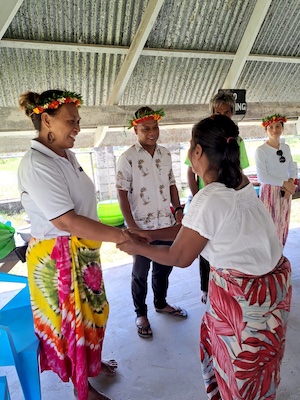
    The 22-month partnership sets out to empower local women to enable greater access to electricity and water on Kiribati’s remote outer island, Aranuka.

    It will deliver an off-grid energy solution on Aranuka using a model that is locally appropriate, sustainable over the long term, builds the capacity of women, and provides solar- powered energy to communities that do not currently have access to electricity.

    It aims to improve access to fresh water, as well as safe and renewable energy, helping children better engage in education and allowing greater productivity, economic activity, and practice of culture, among community members. It will achieve this by supplying and installing low-maintenance solar-powered portable batteries, as well as solar powered water pumps and water storage tanks, and establishing women-led infrastructure management committees who are trained in maintaining the equipment. It will also establish a household levy scheme to provide funding for the initiative over the long term.
  • Pacific Health and Sanitation Solutions

    Pacific Health and Sanitation Solutions

    Objectives

    Improve sanitation and hygiene practices of targeted communities, addressing issues such as open defecation, handwashing, and menstrual hygiene management.

    Improve adaptative management of community-based water resources.

    Empower women and girls by directly engaging with them to address their needs as beneficiaries of grant activities.Improve the capacity of partner service providers (FSPK SIDT) in community WASH facilitation, community engagement, and planning skills.

    Award Summary

    Supported by USAID’s Pacific American Fund, Action on Poverty (AOP) is working with local organizations to co-create solutions to improve sanitation and hygiene practices, services, and climate-resilient water management in vulnerable communities across the two countries. Women and girls will play a critical role in developing and implementing WASH strategies to ensure equitable and inclusive programming.

    Expected Outcomes

    • The project seeks to improve access to safe, climate-resilient WASH programming for 1,920 beneficiaries in 18 communities in Kiribati and Solomon Islands. At conclusion, this award will have:
    • Improved the capacity of FSPK and SIDT on community engagement techniques for WASH, GESI, and climate change adaptation.
    • Changed attitudes, norms, and practices around open defecation and handwashing.
    • Strengthened local, climate-resilient water resource management practices.
    • Improved menstrual hygiene management norms and practices.
  • Water access and health security

    Water access and health security

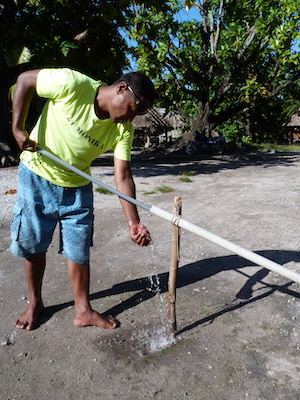
    The project will be implemented on the outer islands of Aranuka, Kuria and Marakei, to empower vulnerable rural communities. In these target islands, most households rely on open wells for domestic water. Shallow ground water is frequently contaminated with seawater, rubbish and human waste. This has increasingly a negative impact on health, especially for women, children, and infants. There is limited food production due to limited fresh water.  Prolonged periods of droughts due to La Nina has also worsened the situation.  Poor diet is also a leading to significant health issues, as this is compounded by limited public awareness of the links about water, sanitation, diet, hygiene, and health.  

    ​ 

    ​The goal of the project is to improve the health and wellbeing of these communities, through better access to and availability of water, increase access to nutritious food and improve community knowledge of health and hygiene. Through improved access to water, nutritious food, and knowledge about good health and hygiene, we expect that there will be an increase in overall community health and wellbeing. 

    ​ 

    ​Improved access to water located at proximity to home can play an important role for the quality of life, and safety of women and children and other vulnerable community members.  

    ​ 

    ​The project outcomes are: 

    1.     ​More community members can readily access water 

    2.     ​More households increase consumption of fresh produce  

    3.     ​Community members have greater knowledge and understanding of personal hygiene practices, nutrition and household and environmental cleanliness 

    4.     ​Women have stronger leadership roles in water management.

  • Hello world!

    Welcome to WordPress. This is your first post. Edit or delete it, then start writing!